Healthcare Marketing
Dental PPC: How UK Practices Run Google Ads That Book Patients

By Dr. Muhammad Abdullah, Pharm.D, MBA · Founder & Chief Systems Architect
Updated · 4 min read

The short answer
Dental PPC works best when Google Ads campaigns are split by treatment, such as implants, Invisalign, emergency appointments and new private patients, each with its own ads, budget and landing page. Exclude job, training and NHS-only searches where they do not fit, track calls to booked appointments, and set budgets from your target cost per new patient.
Key takeaways
- Split campaigns by treatment so each has its own budget, ads and landing page.
- Implants and Invisalign usually justify the most budget because one case is worth many months of spend.
- Run emergency campaigns only when someone can answer the phone.
- Optimise towards booked appointments imported from your practice software, not raw calls.
Somewhere right now, a dental practice is paying for a click from someone searching “dental nurse jobs near me”. Nobody added “jobs” as a negative keyword, and the campaign report still counts the click as engagement.
Dental PPC can fill a private treatment diary within weeks. It can also quietly burn money when one campaign tries to sell every service and every phone call counts as a new patient. This guide is for UK practice owners and managers who want to know how a profitable dental Google Ads account is built, and how to tell whether yours is.
Does dental PPC work?
Dental PPC works for treatments people search for with clear intent and high value. Searches such as “dental implants near me”, “Invisalign cost” and “emergency dentist open now” come from people ready to act, and a well-structured account can turn them into consultations quickly.
It fails in two predictable ways. The first is a single campaign trying to sell everything, so budget drifts to cheap clicks for low-value services. The second is counting every call as a conversion, including existing patients rescheduling a check-up. Fix both and most accounts improve before you spend a pound more.
How should a dental Google Ads account be structured?
Organise the account by treatment, so each campaign has its own budget, ads, landing page and goal.
| Campaign | Example searches | Landing page | Goal |
|---|---|---|---|
| Implants and full-arch | “dental implants cost”, “all on 4 near me” | Implant page with cost guidance and finance | Implant consultations |
| Invisalign and aligners | “Invisalign dentist near me” | Aligner page with consultation offer | Aligner consultations |
| Emergency | “emergency dentist open now” | Call-first page with opening hours | Same-day calls |
| New private patients | “private dentist accepting new patients” | Fees and booking page | New patient bookings |
| Brand | Your practice name | Homepage or booking page | Protect brand clicks |
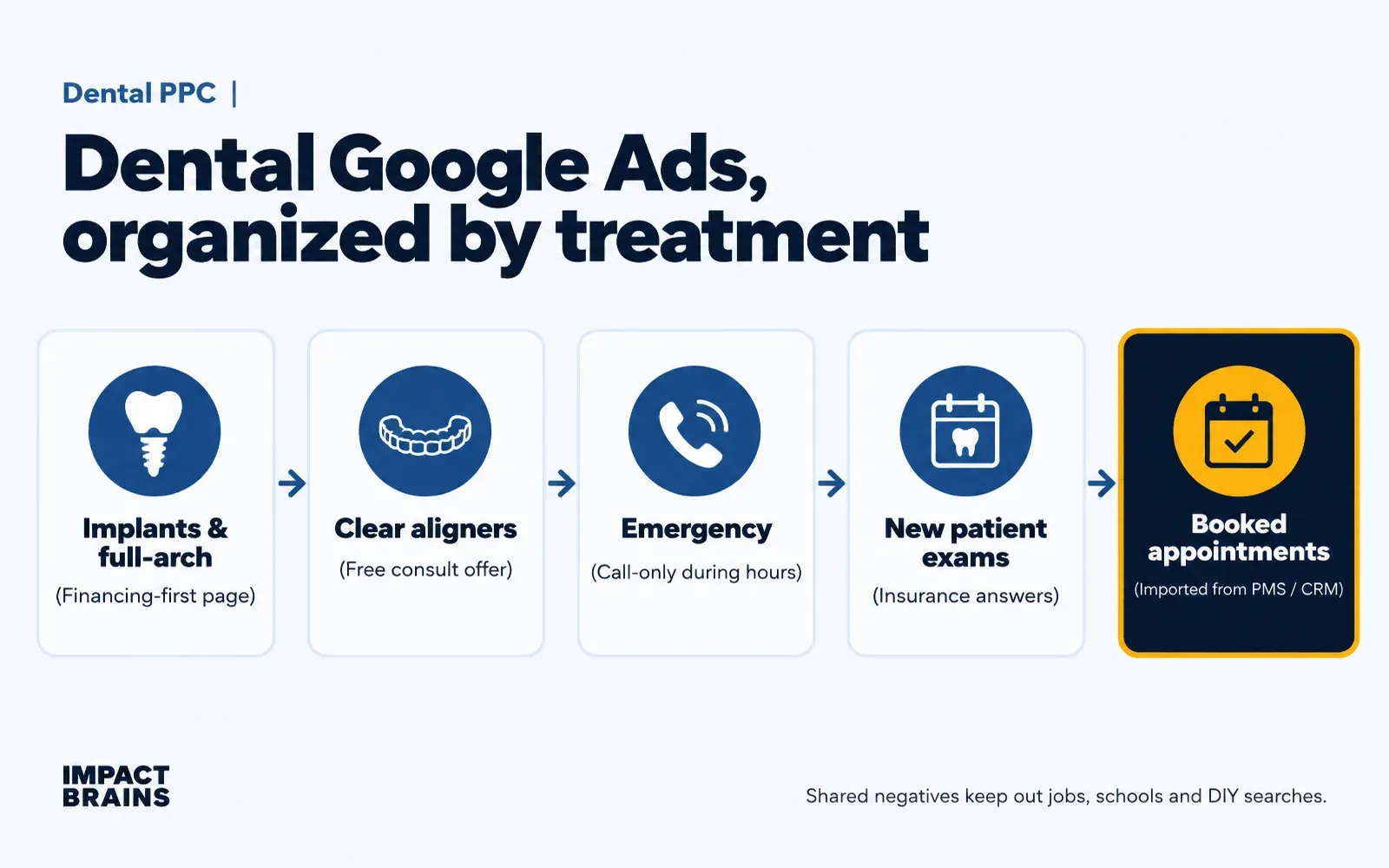
Separating treatments shows you which ones pay. In many practices, a single implant case covers several months of advertising, while routine work struggles to cover its clicks.
Which negative keywords should UK dentists use?
Start with a shared negative list and expand it every week from the search terms report.
- Jobs and training: jobs, vacancies, salary, dental nurse, hygienist course, apprenticeship
- Education: dental school, university, degree, CPD
- DIY and products: at home, kit, how to, toothpaste brands
- Price-only searches you do not serve: free, cheap (unless you offer it)
- NHS-only searches, if you only offer private treatment
- Unrelated animals and trade: vet, dog, cat, supplies, wholesale
Review the search terms report weekly. New irrelevant searches appear constantly, especially with broad match.
What makes a dental landing page convert?
A dental landing page converts when it answers the patient’s questions before they have to ask.
- A headline matching the treatment and area
- Cost guidance and finance options above the fold, worded within FCA rules if you promote credit
- Dentist profiles with GDC registration and real photos of your practice
- Reviews that mention the treatment, shared with permission
- Click-to-call plus a short form of three to five fields
- Fast mobile loading, with the main content visible in under 2.5 seconds
How should dental practices track Google Ads?
Count a qualified new-patient call separately from a form fill and from a booked appointment. Then import booked appointments from your practice management software or CRM into Google Ads as offline conversions, using the click ID only. Smart Bidding learns from whatever you tell it is a conversion, so tell it about real patients.
Never send health or treatment details to Google. The click ID and the fact that an appointment happened are enough for bidding to learn.
How much should a dental practice spend on PPC?
Work backwards from the patients you want. Here is a worked example, labelled illustrative. Say you want 20 new private patients a month. If half of enquiries book, 80% of those attend and 70% are suitable for treatment, you need about 71 enquiries. If your landing page converts 8% of clicks and clicks cost £4, that is roughly 890 clicks and a budget of about £3,550 a month.
Your own numbers will differ by town, treatment and competition. Our Google Ads budget calculator runs the same sum with your figures.
What to do next
Start with structure and tracking before you touch the budget. Split the account by treatment, add the negative list above and separate new-patient calls from existing-patient calls. Then connect booked appointments as offline conversions so bidding learns which searches bring patients.
If you would like a second opinion first, our free audit reviews your account, landing pages and tracking and shows which change will bring the most new patients. See how PPC fits with local SEO, your website and follow-up in our dental marketing system.
Frequently asked questions
Do Google Ads work for UK dentists?
Yes, for high-value private treatments and emergency appointments, provided campaigns are split by treatment, negative keywords exclude job and training searches, and calls are tracked through to booked appointments.
How much should a dental practice spend on Google Ads?
Work backwards from the new patients you want, your booking and attendance rates and your local cost per click. Our budget calculator does the maths in pounds. Implant-focused practices usually spend more because each case is worth more.
Which dental treatments are best for PPC?
Implants, full-arch treatment and Invisalign are high value, and emergency dentistry brings fast local calls. Routine check-ups usually do better through local SEO.
Can dentists advertise Invisalign on Google?
Yes, with accurate claims. Check trademark rules for the brand name and Google's healthcare policy, and keep claims within the CAP Code and GDC guidance.
Should dentists use Performance Max?
Only after Search campaigns are profitable and booked-appointment data is flowing back, so Performance Max has the right signal to learn from.

About the author
Dr. Muhammad Abdullah holds a Doctor of Pharmacy and an MBA and founded Impact Brains. Over eight years he has managed more than $7M in ad spend and deployed Google Tag Manager across 50+ accounts in nine countries. He created the IMPACT Marketing System and leads the team that builds it for clients. He is not a medical doctor and does not give clinical advice.
Sources
- Healthcare and medicines policy, Google Ads Help. Accessed 15 November 2026.
- About offline conversion imports, Google Ads Help. Accessed 15 November 2026.
- About Smart Bidding, Google Ads Help. Accessed 15 November 2026.
- The CAP Code (non-broadcast advertising), Advertising Standards Authority. Accessed 15 November 2026.
This article is general information only and is not legal, medical, financial or regulatory advice. Rules differ between the UK, US and other markets and change over time. Take advice from a qualified professional before acting on anything specific to your organisation.