Healthcare Marketing
Google Ads for Doctors and Private Clinics: How to Do It Within the Rules

By Dr. Muhammad Abdullah, Pharm.D, MBA · Founder & Chief Systems Architect
Updated · 4 min read

The short answer
UK doctors and private clinics can run Google Ads as long as ads and landing pages follow Google's healthcare and medicines policy and UK rules, including the ASA CAP Code and the MHRA ban on advertising prescription-only medicines to the public. Build one campaign per treatment, send each to a dedicated page, exclude job and training searches, and track booked consultations without sending patient data to Google.
Key takeaways
- Most private medical services can be advertised. Prescription-only medicines cannot be promoted to the public in the UK.
- Structure campaigns by treatment, not by a general services list.
- Count booked consultations, not clicks or short calls, or bidding learns the wrong thing.
- Google's personalised advertising policy prevents targeting or remarketing based on health conditions.
When a clinic tells us Google Ads does not work, we look at the conversion settings first. Most of the time, Google was optimising for something that was not a patient: a page view, a ten-second call or a form submitted by a job applicant.
This guide is for UK private doctors, clinic owners and practice managers. It covers what you can and cannot advertise, how to structure an account, how to set a budget in pounds and how to track results without sharing patient information.
Can doctors advertise on Google Ads in the UK?
Yes. Private doctors and clinics can advertise consultations and services on Google, and search ads are one of the fastest ways to reach patients who are actively looking for treatment. The condition is compliance: ads, keywords and landing pages must follow Google’s healthcare and medicines policy and UK advertising rules.
- Generally allowed: consultations, private GP and specialist services, physiotherapy, dental care and many elective procedures
- Restricted or certification required: online pharmacies and some medicine-related services, depending on Google’s rules for the UK
- Not allowed: advertising prescription-only medicines to the public, misleading health claims and guaranteed outcomes
One more rule catches clinics out. Google’s personalised advertising policy prevents targeting or remarketing to people based on health conditions. Search intent does the targeting for you.
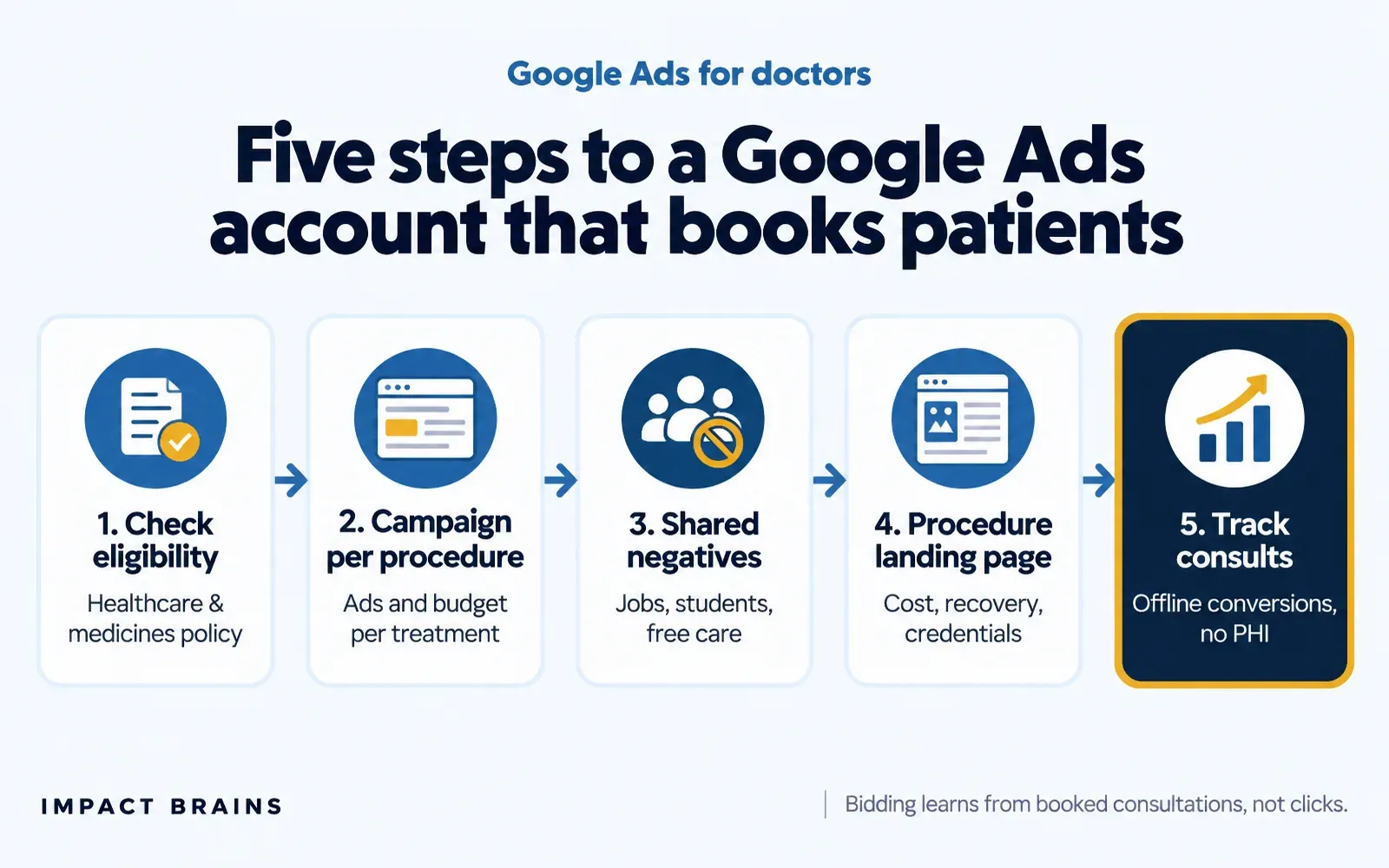
How do you set up Google Ads for a private clinic?
- Confirm eligibility. Check each service against Google’s healthcare policy and the CAP Code, and get certification first where it is required.
- Build one campaign or ad group per treatment. Each needs its own keywords, ads and budget.
- Add shared negative keyword lists. Exclude jobs, salaries, training, NHS-only and irrelevant searches from day one.
- Send each treatment to a dedicated landing page. Answer cost, suitability, recovery and credentials, with a short form and a phone number.
- Track what matters. Count qualified calls, form submissions and booked consultations separately, then import outcomes from your CRM.
Why should campaigns be organised by treatment?
Each treatment has different searchers, values and questions. A surgical patient compares surgeons and recovery times, while someone booking a skin consultation compares availability and price. Mixing them in one campaign hides which treatments pay.
Our clearest example is a facial plastic surgery practice in Washington, D.C. Rebuilding campaigns by procedure and changing the conversion action to consultation requests cut cost per conversion from $141.68 to $61.12 in three months, while conversions rose from 34 to 99.
| Campaign | Example keywords | Landing page |
|---|---|---|
| High-value treatment | “knee replacement surgeon private”, “[treatment] cost” | Treatment consultation page |
| Second treatment | “private physio near me” | Treatment page with booking |
| Brand | Clinic and clinician names | Homepage or booking page |
| Condition-led, where allowed | “back pain specialist near me” | Condition page with booking |
How much should a private clinic spend on Google Ads?
Work backwards from patients. Here is a worked example, labelled illustrative. Say you want 15 new consultations a month and half of enquiries book, so you need 30 enquiries. If your landing page converts 6% of clicks at £3.50 a click, you need about 500 clicks, or roughly £1,750 a month.
Costs per click vary widely by treatment and town. Our Google Ads budget calculator runs the same sum with your numbers.
How do you track Google Ads without sharing patient data?
Track events, not people. Fire conversions on non-identifying actions, such as a qualified call, a form submission or a booking. Route them through a server-side container that strips personal and health details, and import booked consultations as offline conversions using the Google click ID and a timestamp only.
- No pixels or conversion tags on patient portals or pages that collect health information
- Enquiry forms that ask only what is needed to arrange a consultation
- A clear definition of a qualified call, such as a new caller who stays on the line for a minute or more
In the UK, health data is special category data under UK GDPR, so involve your data protection lead in the design. Clinics that also serve US patients should review HIPAA requirements with US counsel.
What should a clinic landing page include?
- A headline that matches the search, for example “Private knee assessment in Leeds”
- Clinician credentials, registration and a real photo above the fold
- Price guidance, suitability and recovery information
- Genuine reviews, shared with permission
- A short form of three to five fields and a click-to-call button
- No guarantees, misleading results or prescription-only medicine promotion
What are the most common mistakes clinics make?
- One campaign for every service, so budget flows to the cheapest clicks
- Broad match without negatives, paying for job seekers and students
- Sending ads to the homepage
- Counting every call or page view as a conversion
- Ignoring policy until ads are disapproved
- Paying an agency a percentage of spend, which rewards spending more
What to do next
Check three things this week. What does your account count as a conversion? Does each main treatment have its own campaign and landing page? Are booked consultations flowing back to Google? Fix those in that order before increasing your budget.
Our healthcare PPC service builds on everything above, and our free audit shows exactly where your current account stands.
Frequently asked questions
Can doctors advertise on Google in the UK?
Yes. Private doctors and clinics can advertise consultations and services on Google, provided ads and landing pages follow Google's healthcare and medicines policy, the CAP Code and their professional regulator's guidance.
Can a clinic advertise weight-loss injections or Botox?
Not the medicines themselves. Prescription-only medicines cannot be advertised to the public in the UK. Clinics can promote consultations and services, with careful wording reviewed by their compliance adviser.
How much should a private clinic spend on Google Ads?
Work backwards from the new patients you need, your conversion rates and your local cost per click. Our budget calculator runs the numbers in pounds.
Can we remarket to people who visited our treatment pages?
Google's personalised advertising policy restricts targeting based on health. Avoid building remarketing audiences from sensitive pages and rely on search intent instead.
Should we pay an agency a percentage of ad spend?
A percentage fee rewards spending more. A flat fee keeps the focus on cost per patient.

About the author
Dr. Muhammad Abdullah holds a Doctor of Pharmacy and an MBA and founded Impact Brains. Over eight years he has managed more than $7M in ad spend and deployed Google Tag Manager across 50+ accounts in nine countries. He created the IMPACT Marketing System and leads the team that builds it for clients. He is not a medical doctor and does not give clinical advice.
Sources
- Healthcare and medicines policy, Google Ads Help. Accessed 15 November 2026.
- Personalised advertising policy, Google Ads Help. Accessed 15 November 2026.
- About offline conversion imports, Google Ads Help. Accessed 15 November 2026.
- Advertise your medicines, Medicines and Healthcare products Regulatory Agency (GOV.UK). Accessed 15 November 2026.
- The CAP Code (non-broadcast advertising), Advertising Standards Authority. Accessed 15 November 2026.
This article is general information only and is not legal, medical, financial or regulatory advice. Rules differ between the UK, US and other markets and change over time. Take advice from a qualified professional before acting on anything specific to your organisation.