Healthcare Marketing
Dental SEO: How UK Practices Rank for Dentist Near Me

By Dr. Muhammad Abdullah, Pharm.D, MBA · Founder & Chief Systems Architect
Updated · 5 min read

The short answer
Dental SEO helps a UK practice appear when nearby patients search for a dentist or a treatment. It rests on a complete Google Business Profile, a page for every treatment and location, a steady flow of genuine reviews, consistent practice details, fast mobile pages with online booking, and structured data. Distance is fixed, so relevance and prominence are what you can improve.
Key takeaways
- Google ranks local results on relevance, distance and prominence. You can influence two of the three.
- A single services page cannot rank for implants, Invisalign, whitening and emergency care at the same time.
- Genuine, recent reviews matter, and replies must never confirm that someone is a patient.
- Measure dental SEO in new private patients from organic calls and bookings, not rankings alone.
Most dental websites we audit have one “Services” page listing twenty treatments, a Google Business Profile that was set up once and left alone, and a handful of reviews from three years ago. The practice is often excellent. Online, it looks like every other practice on the high street, so Google has no reason to show it first.
This guide is for UK practice owners and managers who want more private patients from search, particularly for implants, Invisalign, cosmetic work and emergency appointments. It covers how Google chooses which dentists appear, a 12-step checklist you can work through, and how to tell whether your SEO is producing patients or just reports.
How does Google decide which dentist shows up for “dentist near me”?
Google ranks local results on three factors: relevance, distance and prominence. Relevance is how well your profile and website match the search. Distance is how far you are from the person searching. Prominence is how well known and well regarded you are, based on reviews, links and mentions across the web.
You cannot move your practice closer to every patient, so the work focuses on relevance and prominence. A practice two miles away with a complete profile, detailed treatment pages and steady reviews can outrank one around the corner that has done none of it.
Patients also search beyond the map pack. Someone researching dental implants may search “dental implants cost” or “how long do implants last” long before they search for a practice. Those searches are won by treatment pages on your website, not by your profile.
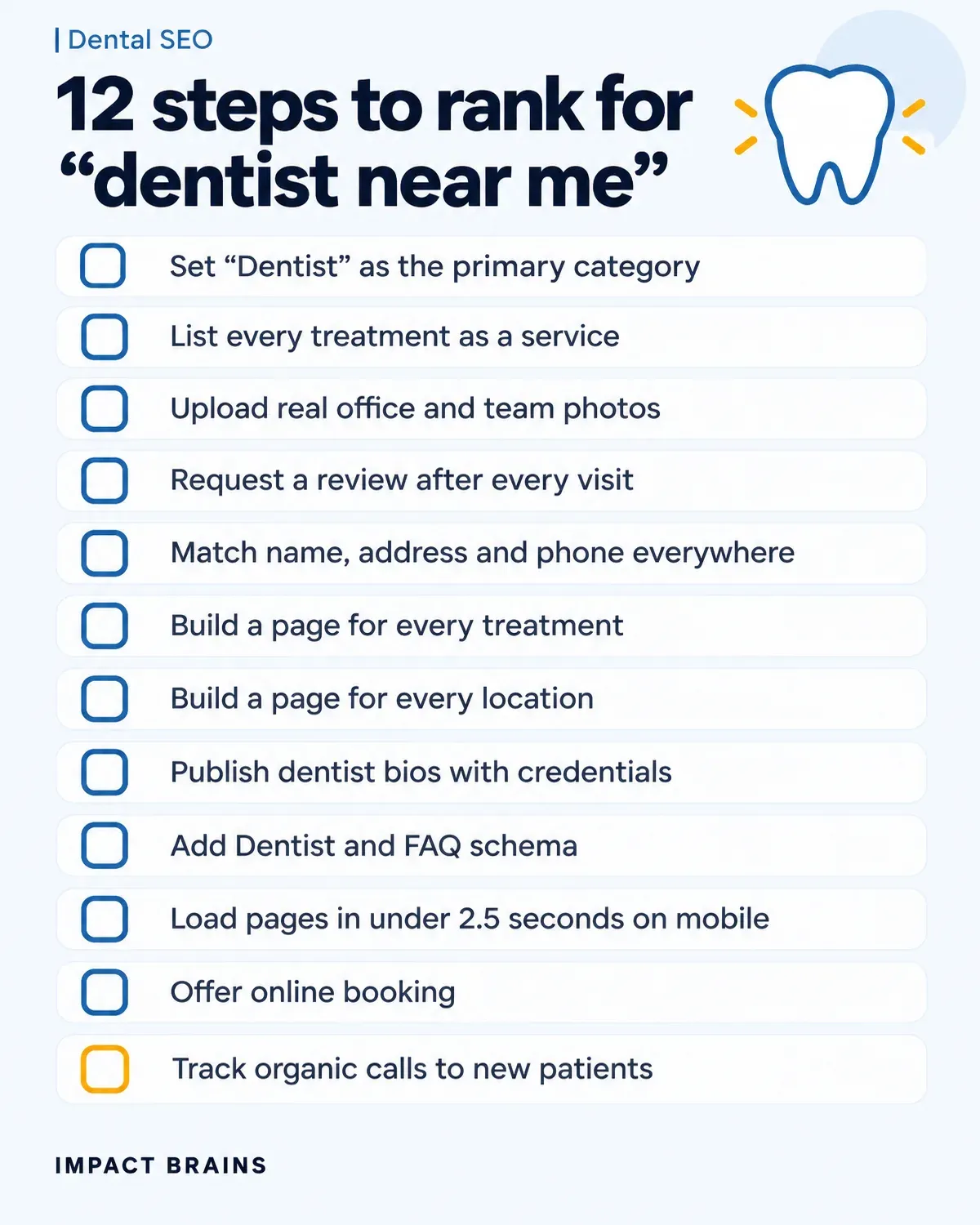
Dental SEO checklist: 12 steps
- Set the right primary category. Use “Dentist”, or your specialty such as “Orthodontist”, with accurate secondary categories.
- List every treatment as a service. Implants, Invisalign, whitening, crowns, emergency appointments and children’s dentistry.
- Upload real photos. Your surgery, team and equipment, refreshed regularly. No stock images.
- Ask for reviews after appointments. Send a polite text with a direct link. Never incentivise reviews.
- Reply without confirming treatment. A reply like “thanks for your kind words” protects patient confidentiality. Never mention what someone had done.
- Keep practice details consistent. Name, address and phone number identical on your site, profile and directories.
- Build a page for every treatment. Cost guidance, suitability, the process, recovery, FAQs and finance options.
- Build a page for every location. Local team, photos, opening hours, parking and directions.
- Publish dentist profiles. Qualifications, GDC registration, memberships and a real photo.
- Add structured data. Dentist and LocalBusiness markup on the right pages, matching what is visible.
- Make pages fast on mobile. Aim for the main content to load in under 2.5 seconds.
- Track new patients. Call tracking and booking data tied to organic visits, so you can see real results.
Which dental pages rank best?
Treatment and location pages do most of the heavy lifting. Each should answer the questions a patient asks before they pick up the phone.
| Page | Searches it can win | Must include |
|---|---|---|
| Dental implants | “dental implants cost”, “implants near me” | Cost guidance, finance, suitability, process and recovery |
| Invisalign and aligners | “Invisalign near me”, “clear aligners cost” | Process, timeline, cost and provider status |
| Emergency dentist | “emergency dentist open now” | Opening hours, same-day policy, phone number first |
| Location pages | “dentist in [town]” | Local team, photos, parking and directions |
| Children’s dentistry | “children’s dentist near me” | Age range, first-visit guide and how you put children at ease |
A word on finance: if your treatment pages mention payment plans or credit, those promotions are regulated. Check your wording with your finance provider, because promoting credit is subject to Financial Conduct Authority rules.
How should dental content stay within GDC and ASA rules?
Dental content must be accurate, verifiable and not misleading. The General Dental Council expects dentists to advertise responsibly, and the ASA’s CAP Code applies to every claim on your website and in your ads. In practice that means no guaranteed results, no unqualified superlatives such as “the best dentist in town”, and clinical statements approved by your dentists.
Before-and-after images need particular care. If you use them, they must be genuine, show typical results and have the patient’s written consent. Many practices keep them on treatment pages only and leave them out of adverts.
How do dentists appear in AI answers?
Google’s AI Overviews and AI assistants cite pages that answer questions clearly and come from sources they can trust. That means a direct answer in the first lines of each section, consistent practice details everywhere, visible credentials and genuine reviews.
Write each treatment page so its opening paragraph could stand on its own as an answer: “Dental implants usually take three to six months from first appointment to final crown, depending on whether bone grafting is needed.” Specific, plain and checked by a dentist.
How do you know if dental SEO is working?
Rankings are a signal, not a result. The numbers that matter are calls, booking requests and new private patients from organic search and your Google Business Profile. Set up call tracking and booking tracking before you start, so you have a baseline to compare against.
Here is a simple worked example, labelled illustrative. Say organic search brings 40 booking requests a month, 60% attend and 30% of those go ahead with treatment. That is about seven new treatment patients a month from SEO. If an average implant or aligner case is worth £3,000, you can judge the monthly SEO fee against roughly £21,000 of treatment value.
How much does dental SEO cost?
Most UK practices pay a fixed monthly fee for six to twelve months. The price depends on the number of locations, how many treatments you want to rank for and how competitive your area is. A single-site practice in a market town needs less work than a group competing in central London.
Be wary of contracts that promise rankings or guaranteed patient numbers. Nobody controls Google. Ask instead for a clear plan, monthly reporting in new patients and the freedom to leave if results do not come.
What to do next
Start with the three changes that make the biggest difference for most practices. First, complete your Google Business Profile with every treatment as a service and fresh photos. Second, split your services page into proper treatment pages, starting with your most valuable treatment. Third, set up a simple, automated review request after every appointment.
If you would rather know exactly where your practice stands before changing anything, our free audit covers your profile, website, tracking and follow-up, and shows which fix will bring the most new patients first. Learn more about our SEO for dentists service or the wider dental marketing system.
Frequently asked questions
How long does dental SEO take?
Google Business Profile and on-page fixes can lift map pack visibility within a few months. Rankings for competitive treatment searches in busy towns usually build over six to twelve months of steady work.
What is the most important dental SEO factor?
For near-me searches, a complete and accurate Google Business Profile with a steady flow of recent, genuine reviews, supported by relevant treatment and location pages on your website.
How much does dental SEO cost in the UK?
Most practices pay a fixed monthly fee for six to twelve months, priced by the number of locations, treatments and local competition. Ask for reporting in new patients, and avoid anyone who promises rankings.
Do dentists need a page for every treatment?
Yes. Separate treatment pages match how patients search and give Google clear signals about what you offer. They also let you answer cost, suitability and process questions properly.
Should NHS and private treatments be on the same page?
Keep them clearly separated. Patients searching for private implants or Invisalign want different information from those looking for NHS check-ups, and mixed pages confuse both groups.

About the author
Dr. Muhammad Abdullah holds a Doctor of Pharmacy and an MBA and founded Impact Brains. Over eight years he has managed more than $7M in ad spend and deployed Google Tag Manager across 50+ accounts in nine countries. He created the IMPACT Marketing System and leads the team that builds it for clients. He is not a medical doctor and does not give clinical advice.
Sources
- How to improve your local ranking on Google, Google Business Profile Help. Accessed 15 November 2026.
- Guidelines for representing your business on Google, Google Business Profile Help. Accessed 15 November 2026.
- Introduction to structured data markup in Google Search, Google Search Central. Accessed 15 November 2026.
- Creating helpful, reliable, people-first content, Google Search Central. Accessed 15 November 2026.
- The CAP Code (non-broadcast advertising), Advertising Standards Authority. Accessed 15 November 2026.
This article is general information only and is not legal, medical, financial or regulatory advice. Rules differ between the UK, US and other markets and change over time. Take advice from a qualified professional before acting on anything specific to your organisation.